If you don't find homes in your interested area, please let us know by email to us at randyconsulting@gmail.com or call 202-455-6608

Published Local Real Estate Market Buy and Sell Statistics and Analysis by Zip Code
20871 20874 20850 20854 20817
20852 21703 21740 21042
The above publishes can be found on Local Chinese Newspaper

Most current data charts and tables on Home Price

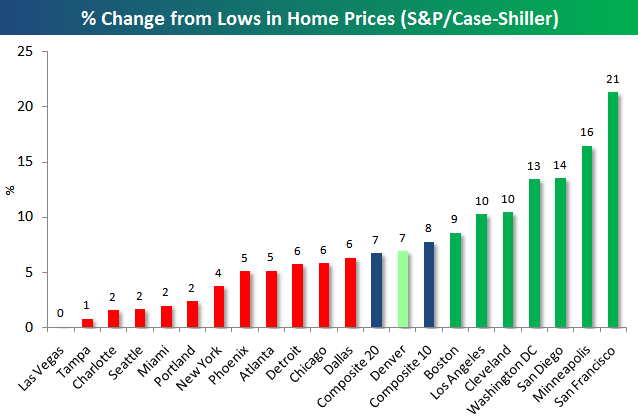
The August S&P/Case-Shiller housing numbers were released yesterday, and below we provide a number of charts and tables highlighting recent trends in both the composite nationwide indices and the 20 individual cities that are tracked. Unfortunately the bounce off of the lows for housing has stalled in recent months. Just five cities saw month-over-month increases in home prices, while 15 cities and both the 10- and 20-city composite indices saw declines. Stop the presses, because Detroit saw the biggest month-over-month gains in August at 0.52%. Chicago, Washington DC, New York, and Las Vegas were the other 4 cities that gained in August. Phoenix, Dallas, Portland, and Atlanta saw the biggest month-over-month declines in August.
On a year-over-year basis, the composite 10-city index is up 2.52%, with San Francisco, San Diego, Los Angeles, and Washington DC leading the way. Las Vegas, Tampa, and Charlotte have the weakest year-over-year numbers.

Prices are still 8% off of the lows for the composite 10-city index but they stalled out over the summer. In the first chart below, we highlight where each city currently stands versus its recession lows, and in the chart below that we highlight how much prices have come off of their post-recession highs as of August. As shown, San Francisco has seen by far the biggest bounce off of its lows at 21%. Minneapolis ranks second at 16%, followed by San Diego (14%), Washington DC (13%), Cleveland (10%), and Los Angeles (10%). Boston is 9% off of its lows, New York City is just 4% off of its lows, and Miami is 2% off its lows. Las Vegas still continues to struggle mightily as prices still haven't bounced at all.
click to enlarge

限购令"凶猛" 全国29城11月计划开盘量降三成

截至10月22日搜房网数据监控中心监控的全国29个大中城市中,24城普通商品住宅项目11月计划开盘量环比10月大幅下降,北京、深圳、广州降幅在五成左右,贵阳降幅最大达到77.3%。
全 国29大城市中共有564个普通商品住宅项目计划于11月开盘,较10月计划开盘量降31.3%。据统计,2010年10月29个城市商品住宅项目计划开 盘821个。包括广州、成都、长春在内的7个城市11月计划开盘量环比10月降50%以上,其中贵阳降幅最大,达到77.3%;另有北京、深圳、广州、杭 州、武汉等17个城市的商品住宅项目计划开盘量均有不同程度的降低。在搜房网数据监控中心监控的29个大中城市中,仅有上海、东莞、福州三个城市住宅项目 计划开盘量较10月有所上涨,另外海南、昆明两城市11月计划开盘数量与10月持平。
截至2010年10月22日,全国共有14个 城市颁布“限购令”,在搜房网数据监控中心监控的北京、天津、上海、南京、广州、深圳、杭州、大连、福州和三亚10个城市中,仅上海、福州两城市计划开盘 量有少量增长,其余8个城市11月商品住宅项目计划开盘量均较10月有所降低。
截至10月22日,在搜房网数据监控中心监控的全国29个大中城市中,普通商品住宅项目10月实际开盘量513个,为10月计划开盘量的62.5%。
全国29个大中城市10月、11月计划开盘数比较
城市11月计划开盘10月计划开盘量环比备注
北京2445下降46.7%已颁布限购令
上海8272上升13.9%已颁布限购令
广州2761下降55.7%已颁布限购令
天津2640下降35%已颁布限购令
深圳1323下降43.5%已颁布限购令
南京4460下降26.7%已颁布限购令
杭州1630下降46.7%已颁布限购令
大连67下降14.3%已颁布限购令
福州1412上升16.7%已颁布限购令
三亚1119下降42.1%已颁布限购令
苏州4149下降16.3% 
长春830下降73.3% 
武汉3049下降38.8% 
东莞2319上升21.1% 
重庆4243下降2.3% 
贵阳522下降77.3% 
海南1414持平 
呼和浩特510下降50% 
济南915下降40% 
昆明1313持平 
昆山922下降59.1% 
南昌814下降42.3% 
南宁911下降18.2% 
青岛2235下降37.1% 
成都1846下降60.6% 
太原1421下降33.3% 
唐山67下降14.3% 
西安1718下降55.6% 
郑州814下降42.9% 
29城市合计564821下降31.3% 
全国29个大中城市10月、11月计划开盘数比较
(数据来源:搜房网数据监控中心  数据监控截至2010年10月22日)

全国29城市10月、11月计划开盘比较图
(数据来源:搜房网数据监控中心  数据监控截至2010年10月22日)

How Buyers Compete in a Sellers' Market

How Buyers Compete in a Sellers' Market
No matter the market, sellers can find a competitive edge, whether it be through pricing, staging, or even negotiating closing costs.
What about buyers? Do they have any hope for an edge during a sellers market?
A sellers market is one which favors the seller. Perhaps you find yourself in a hot area where homes garner multiple offers and bidding wars. Or perhaps you live in an area where prices are appreciating or there is only a small inventory of homes for sale. No matter the situation, buyers can still find ways to gain an advantage.
Here are a few tips that might do just that.
1. Pre-approval: Be sure to start your home buying process by getting pre-approved for a mortgage. This will prove to your potential seller that you are ready, willing, and able to buy their home. A pre-approval will also give you an exact number of how much money you can borrow, and thus spend.
2. Be ready to buy: There can be no hesitation during a sellers market. There will be other buyers waiting to to grab up the same deal you just found. If the numbers work out in your favor for a home you like, then be ready to put in a strong offer.
3. Know your budget: You may be approved for a loan of up to $300,000, but you only want to spend $250,000 as your max. Be sure to know ahead of time what your budget really is.
4. Make a strong offer: In a sellers market, homes can expect to receive nearly if not all of their asking price. And in many cases, you may even find a home sells for more than the asking price. So, in order to make both a good impression on the seller so they take your interest seriously, as well as to beat out the competition, be sure to present a strong first offer.
5. Be willing to negotiate terms: This means if a seller needs 60 days until closing, do what you can do accommodate them. Or maybe they are unwilling to make a repair before you move in, but are willing to pay you the repair costs instead. Be willing to work with a seller, if it means getting the home you desire.
These simple tips can make a big difference when it comes to buying in a sellers market.

Home Builder Confidence Rises For First Time in Months

Home builder confidence for newly built, single-family homes rose three points to 16 on the National Association of Home Builders/Wells Fargo Housing Market Index (HMI) for October.
AP

This was the first improvement registered by the HMI in five months, and returns the index to a level last seen in June of this year, according to the survey.
Readings below 50 indicate negative sentiment about the market. The last time the index was above 50 was in April 2006.
High unemployment, slow job growth and tight credit have kept people from buying homes.
But all three of the HMI’s component indexes registered gains in October.
The index gauging current sales conditions rose three points to 16, while the index gauging sales expectations in the next six months rose five points to 23 and the index gauging traffic of prospective buyers rose two points to 11.
Builder confidence also improved across every region in October. The South and West each posted four-point gains, to 18 and 12, respectively, while the Northeast and Midwest each posted single-point gains, to 17 and 13, respectively.

Title Insurance Woes Illustrate Liabilities of Foreclosue Mess Concentrated in TBTF Banks

There are so many fronts to the foreclosure crisis that it’s now becoming difficult to stay on top of all of them.
One development Monday that didn’t get the attention it deserved is the fact that Bank of America is now eating title insurance liability on foreclosed properties sold by its servicer. Per Bloomberg:
Bank of America’s agreement with Jacksonville, Florida- based Fidelity National calls for the lender to cover the title insurer’s costs in the event of an error in the company’s processing of foreclosure documents, Sadowski said. The bank will notify the insurer in each case that the foreclosure complies with state laws and regulations.
Bank of America is in talks with other title insurers for similar agreements, said Richard Bramhall, the bank’s chief title officer. He declined to name the other companies.
This is a big deal for several reasons:
1. The liability in case of a wrongful foreclosure is large. There is no way for the wronged borrower to get his house back, so title insurance is the only recourse. As Bob Lawless explained in Credit Slips:
…most every (or maybe even every–I’ll let someone else do the 50-state survey) state provides the strongest possible finality protections for deeds obtained through foreclosure sales. We also see similar rules for other judicially supervised sales in other contexts such as sales of personal property subject to a security interest or bankruptcy sales….
Suppose Henry and Helen Homeowner lost their home in foreclosure proceeding, and it has since been purchased by Bill and Betty Buyer. Now, Henry and Helen discover the affidavits in their foreclosure proceeding had some of the very same apparently fraudulent signatures reported in the media. When Henry and Helen complain to the court, the answer should be: “Your complaint is against Deutsche Bank (or whoever foreclosed) and not against Bill and Betty. You can recover damages from Deutsche Bank but not eject Henry and Helen from possession.” In turn, this will mean that that Bill and Betty (or their lender) will not have to look to the title insurer for recovery.
2. This means the large banks now effectively have direct exposure to borrowers for screw ups in foreclosures (note that they did earlier, in theory, but this move shortens the process of the money coming from the bank).
3. The liability is via the bank servicer. Note the Bank of American is now the largest servicer in the US (Wells is a close second) by virtue of having bought Countrywide.
4. Some contend that the risk of clouded title means that title insurers may come to require warranties from banks for all properties sold that has securitized mortgages. As Adam Levitin indicated in a Citigroup report, documentation lapses could “cloud title on not just foreclosed mortgages but on performing mortgages.”
It isn’t hard to see that other banks are likely to be required to take the same step as Bank of America, at least if they want to unload foreclosed property.
It isn’t hard to see where this is going. The biggest servicers are part of TBTF banks. The biggest trustees (the folks who were supposed to make sure that the loans all got to the securitization trust properly) are part of TBTF banks. The major structurer/packagers are now all part of TBTF banks.
Isn’t a concentrated financial services industry grand? Any time they screw up, they are too large to be made to pay for their crimes. The die was cast at the beginning of the Obama administration. It was a critical window of opportunity to take over and put new management in the weakest of the big banks (and probably force them to shed operations too) and they instead were coddled and sent back on their merry way.
I guarantee that the losses, between extend and pretend that will no longer be viable (in particular, the unrealistic marks on second mortgages) and the liabilities resulting from this colossal mess, at least one major bank will be insolvent. But the odds of the new special resolution authority being used? I put the odds at pretty much zero.

Andy Xie’s New Call On China Real Estate - English Version

I hope he is wrong again this time as he has been wrong to the China real estate for too many times. But who knows...


Andy Xie’s New Call On China Real Estate

Andy Xie says real estate prices are headed for a slow decline, not a crash.

SHANGHAI, CHINA - NOVEMBER 24:  The Tomson Riv...

As I wrote here, China bear Andy Xie appeared to be have changed his tune in a CNBC interview. Today he confirms that shift in a new column for Bloomberg-Chinese Property Bust Is Morphing Into a Slow Leak-in which he says Chinese real estate prices have peaked and will decline, but much more slowly than he expects. He seems to blame the government for ruining his “Crash Call.”
I am not sure how any economic pundit opining on China can be surprised by the role of the government, especially when the government has repeatedly said it is not interested in a large decline in property prices, just a moderating of their increase.
I know I know, it is crazy to think that Chinese policymakers can manage around market forces that must “inevitably” lead to a crash, as many of the China bears argue. Then again, maybe the bears don’t understand how China works. As I wrote a few months ago in Are There More China Bears Than Panda Bears?:
None of the bearish cases that I have read take into account politics, social stability and the overriding mission of the Communist Party to retain power. The bearish foreign fund managers, pundits and analysts make be making a classic mistake of viewing China through their financial models. But as we learned in the crash of 2008, most of those models are flawed, even when applied to “free markets”.
China may very well have bubbles in many sectors, but bubbles can last for a very long period, especially when you have an authoritarian government, a non-market economy, and a ruling party that took as one of its lessons after the collapse of the Soviet Union the need to deliver fast economic growth at all costs. Maybe that growth is inefficient, maybe it is wasteful, but that doesn’t not mean it has to end anytime soon. The Chinese government still has a lot of ammunition left to keep growth afloat, they are just as adept at marking bad assets to fantasy as Western banks and governments are, and they may very well believe that making the “correct” economic choices risks stability and possibly their political lives…
Readers likely remember that the stock market already crashed in 2007-08, from over 6000 to 1700, and that real estate prices in major cities dropped 20-30% in 2008 after the government took measures reduce liquidity and then the financial crisis hit. The world didn’t end here.
Maybe this time is different and the China Bears are right, and have enough money to stay solvent. Or maybe China Bears will learn that most Western observers of China consistently underestimate the resilience and longevity of the government and this very hard-to-model, very messy creation officially known in China as Socialism with Chinese Characteristics.
As for Andy Xie and his new call for a slow deflating instead of a crash, I recommend he listen to George Soros on whether or not there is a bubble in China:
People see bubbles everywhere. Again, there is no question the financial stimulus has pushed up asset prices. Whether that is a bubble or not actually depends on whether it’s going to be a hard landing or a soft landing. If it is a soft landing, then it is not a bubble. If it is hard landing, it will be a bubble. We’ll only know if it’s a bubble or not later.
Andy Xie is a masterful self-promoter. But investors should be wondering if his economic forecasting abilities match his self-promotion talents.
There will always be long and short opportunities in China. The successful investors will likely be the good stock and sector pickers, not macro “gurus.”

谢国忠:我正式通知泡沫要破 浙江地价或跌80%

我现在正式通知大家,楼市已见顶,接下来将逐步下跌,熊市将持续五年,大城市的平均房价可能会跌一半以上

又到了吃大闸蟹的季节。

煮螃蟹,首先你把蟹放在冷水锅中,它们会觉得又回到了湖里,浑然不觉危险。然后,盖下沉重的锅盖,开火。这时,你可以听见它们抓挠锅壁的声音,开始 轻,然后拼命挣扎,然后轻,再后就偃旗息鼓了。几分钟后,你打开锅盖,蟹壳已成金黄。这时,你就可以蘸着醋姜,享受美味了。

现在,中国的炒房人就像在冷水锅中的螃蟹。他们感觉很好,会时不时地伸伸腿。看不到任何危险。殊不知,自己已经被人盖上锅盖、下面点上了火。马上就要被煮熟了,却尚未发觉。

今年4月,我告诉过读者,楼市泡沫即将破灭时,就会通知大家。现在,楼市已经见顶。在今年余下的时间内,它将逐步下跌。到2012年,人民币升值预期可能会逆转,资本会流出,届时楼市会加速下跌。

中国已进入房地产熊市,将持续五年时间。大城市的平均房价很可能会下降一半以上。土地价格将下降更多。在泡沫最大最疯狂的浙江省,价格可能会下降80%甚至更多。

工资与租金

为什么房价会下跌这么多?当泡沫泄气的时候,房价必须下降到工资和投资收益可以支撑的水平。在中国的房地产市场,现在的租金回报率不到3%,它必须回到5%以上,每平方米的单价则不应超过两月的平均工资。

在泡沫时期,准确断言市场顶部是一门艺术。人类跟风投资的弱点是泡沫的助推剂,总到最后时刻才能醒悟。泡沫破裂通常由资本退潮触发。有时,超量供应会超过投机性需求,足以吓跑投机者。多数泡沫是突然破裂的。但也有个别泡沫是逐渐泄漏的。

1997年,外国资金撤出推高了利率,导致香港楼市泡沫破灭,顷刻间,吸光了这个赌场的所有资金。2000年互联网泡沫的破灭,是因为那些上市公司的 大股东们手中的股票限售期刚过即大规模抛售,惊醒了投机者。而2007年美国楼市泡沫破灭,是因为次贷到期了,投机者发现还不上钱。

逐渐泄气

房地产泡沫的泄气可以持续很多年。20世纪90年代日经225股票平均指数崩盘后,日本楼市泡沫还膨胀了两年。而且它也不是瞬间破灭的,而是在其后的二十年中,以每年大约8%的速度下跌。台湾受日本影响,房价也在缓慢下跌,直到中国疯狂的投机者复苏了房地产市场。

1998年,中国的房地产泡沫也破灭了。三年内,上海房价下跌了三分之二。广东和海南的烂尾楼随处可见。再近点说,上海的房价从2005年5月至2006年底下跌了三分之一。很多商业区的楼盘甚至下跌了一半。

现在的泡沫始于2007年,由宽松的货币政策和人民币升值预期催生,我原以为,它也会在瞬间破灭。但最近的事态发展改变了我的观点。此次的泡沫可能不 会瞬间破灭,而是会慢慢泄气。之前,我以为政府可能会在四季度放松宏观调控,导致房价再次疯涨,泡沫会在2011年下半年或2012年突然破灭。

“脱衣秀”

政府目前仍然没有放宽二三套房的贷款限制。那些最有潜力的买房者受到了管制,这些买房者其实并没有足够的现金,主要依靠贷款买房,因此,房价不能更上一层楼了。

除了信贷政策,流动性也在收紧。人民币的汇率仿佛是一场“脱衣秀”。经过多年等待,都没有看到“真材实料”,对冲基金终于受够了,再也不想等下去了。 尽管美国财长盖特纳又一次大声疾呼人民币被低估了,但市场对此已经麻木了。人民币NDF市场并不指望人民币在明年会大幅升值。

这对流入中国的热钱影响极大。存款业的竞争日趋激烈。银行提供的理财产品极像存款,但提供的利息却比央行规定的利息高得多。

经济衰退?

现在中国房地产价格正在慢慢下跌,并将于2012年加快步伐,届时,中国经济也将会受挫。未来十年内,出口、消费和基础设施将会以7%-8%的速度增长。与近年来相比,这个增速相对较慢,但它更有利于提升工资、家庭生活水平和企业利润。

中国人不能用房屋净值贷款来消费。2000多万套空置房的户主们将会越来越穷或是破产。豪车的销售量可能也会减少。但是中产阶级将更具有购买力,因为他们从投机者那里买房的成本会降低。

为了防止房地产泡沫泄气而影响到其他投资领域,政府必须迅速向银行注资。政府有足够的财力和智力这么做。在过去十年,中国拥有强大的楼市和疲软的消费。而未来十年,情况可能刚好相反。

楼市的投机者们就像冷水锅中的大闸蟹,正在挨煮。但是,趁着现在火小、水温低,聪明人还有时间逃出生天。

(作者为玫瑰石顾问公司董事,经济学家;本文英文版首先发于彭博,财新记者陈璐译)